
Entry points
Doors, windows and side entrances should be reviewed individually to determine where door contacts or another suitable detection method are needed.
The right choice starts with entry points, movement areas and how the site is used—not simply the number of sensors. This guide explains what to confirm before selecting the alarm panel, sensors, alert method and backup power.
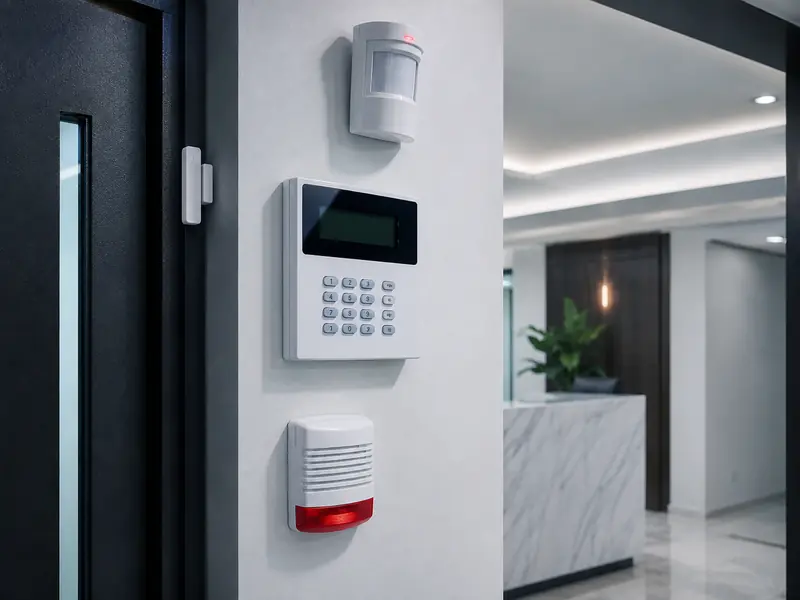
The goal is to cover important entry and movement points while reducing gaps and unwanted alerts and keeping daily operation simple.
Doors, windows and side entrances should be reviewed individually to determine where door contacts or another suitable detection method are needed.
Corridors and interior spaces determine motion-sensor placement, taking viewing angles and normal site activity into account.
Local siren, app, notification or communication module: the available option depends on the selected panel and supported connectivity.
These questions help prevent buying a panel or sensors that do not fit the site or the required operating method.
| Factor | Question to answer | Why it matters |
|---|---|---|
| Entrances | How many doors, windows and access points need monitoring? | Defines the required zones and sensors. |
| Movement | Where does normal movement happen, and where should movement be detected after arming? | Helps place sensors and reduce unwanted alerts. |
| Alerts | Do you need a siren only, or phone alerts as well? | Influences the panel or communication module required. |
| Cabling | Is the site new, finished, or already wired? | Helps decide between wired, wireless or a supported hybrid option. |
| Backup power | What should continue working during a power outage? | Defines battery capacity, testing and maintenance needs. |
A reliable alarm solution is a connected system of panel, sensors, siren, power and alert method. Compatibility should be checked before purchase or expansion.
Each option has suitable use cases, and a hybrid approach may make sense where the selected platform supports it.
A product being described as smart is not enough. Confirm whether alerts depend on an app, internet connection, cellular module or another supported communication method.
Confirm the exact model is supported and check what notifications and user controls are actually available.
Some systems depend on the local network while others support additional communication modules. Define this before installation.
If remote alerting is critical, also review how power or internet failure affects the way alerts are delivered.
Review entrances, movement areas, cabling and any existing alarm equipment.
Choose the panel, sensors, siren and required alert method.
Install devices and cabling or supported wireless links according to the site plan.
Set zones, users and alert behavior according to the selected platform.
Test sensors, siren, alerts and backup power within the agreed project scope.
The decision starts with the existing panel capacity, sensor compatibility, battery condition and cabling before buying a new system.
The cause may be sensor condition, placement or configuration, so diagnosis should come before replacement.
Adding a door, warehouse area or department requires checking available zones and panel capacity.
A communication module or partial upgrade may be possible when the existing panel supports it.
Start by identifying entry points, corridors and spaces that need monitoring, then define the required alert method before choosing the panel and sensors.
Neither option is best for every site. Wired systems suit projects with available cabling, while wireless systems can be practical in finished sites. The decision depends on distance, site conditions and platform support.
Some systems support an app, notifications or a communication module. Model compatibility and the required connection method should be confirmed before purchase.
Many alarm panels support a backup battery, but runtime depends on battery capacity, condition and the devices connected to the system.
An upgrade may be useful when sensors fail, false alerts become frequent, batteries weaken, the site expands or newer alert features are required, after checking compatibility with the existing panel.
Send us your site type, number of entrances and whether phone alerts are required. We can identify what should be surveyed before selecting the panel, sensors and installation method.